Antonin Scalia Youre Crazy if You Think It Wont Happen Again
In Chat: Antonin Scalia
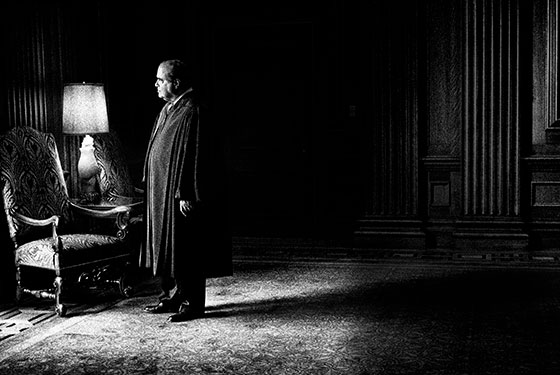
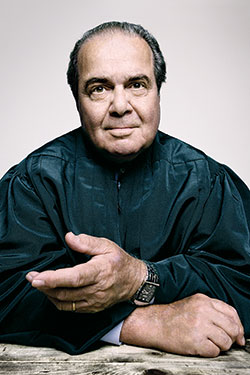
On September 26—a day that just happened to be the 27th anniversary of his swearing-in as associate justice—Antonin Scalia entered the Supreme Court's enormous E Briefing Room and so casually that one might easily have missed him. He is smaller than his king-size persona suggests, and his manner more puckish than formal. Washingtonians may know Scalia as mannerly and disarming, but almost outsiders tend to regard him as either a demigod on stilts or a menace to democracy, depending on which side of the aisle they sit down. A singularity on the Court and an icon on the right, Scalia is perchance more than responsible than any American alive for the mainstreaming of conservative ideas nigh jurisprudence—in detail the principles of originalism (interpreting the Constitution as the framers intended it rather than as an evolving document) and textualism (that statutes must be interpreted based on their words lone). And he has got to be the only justice to ever use the phrase "argle-bargle" in a dissent.
Y'all came to Washington as a lawyer during the Nixon administration, just earlier Watergate. What on Earth was that similar?
It was a distressing time. It was very depressing. Every day, the Washington Mail would come out with something new—it trickled out flake by bit. Originally, you thought, It couldn't be, but it apparently was. As a young human being, you lot're dazzled by the power of the White House and all that. But power tends to corrupt.
Then you lot served in the Ford assistants. That must accept been an clumsily lone fourth dimension to exist a young conservative.
Information technology was a terrible fourth dimension, not for the Republican Party, but for the presidency. Information technology was such a wounded and enfeebled presidency, and Congress was merely eating us alive. I mean, nosotros had a president who had never been elected to anything except … what? A district in Michigan? Everything was in chaos.
It was a fourth dimension when people were talking about "the imperial presidency." I knew very well that the 900-pound gorilla in Washington is non the presidency. It's Congress. If Congress tin can get its act together, information technology tin can whorl over the president. That's what the framers thought. They said you have to enlist your jealousy against the legislature in a democracy—that will be the source of tyranny.
But weren't you just saying that you learned from Watergate that presidents aren't incorruptible?
What, and Congress is? I hateful, they're all human being beings. Ability tends to decadent. But the power in Washington resides in Congress, if it wants to use it. It can do anything—it can terminate the Vietnam State of war, it can make its will felt, if it can e'er get its act together to practice anything.
Had y'all already arrived at originalism as a philosophy?
I don't know when I came to that view. I've always had it, equally far every bit I know. Words have meaning. And their meaning doesn't change. I mean, the notion that the Constitution should simply, by decree of the Court, mean something that it didn't hateful when the people voted for information technology—bluntly, you should ask the other side the question! How did they ever become in that location?
But every bit police force students, they were taught that the Constitution evolved, right? You got that same message consistently in class, even so you lot had other ideas.
I am something of a contrarian, I suppose. I feel less comfy when everybody agrees with me. I say, "I better reexamine my position!" I probably believe that the worst opinions in my courtroom accept been unanimous. Because at that place's nobody on the other side pointing out all the flaws.
Really? And so if you had the chance to have eight other justices just like you, would you not want them to be your colleagues?
No. But six.
That was a serious question!
What I practice wish is that we were in understanding on the basic question of what we call up we're doing when we interpret the Constitution. I mean, that's sort of rudimentary. Information technology'south sort of an embarrassment, really, that we're non. Only some people think our chore is to keep it up to appointment, requite new meaning to whatsoever phrases it has. And others think it's to give information technology the significant the people ratified when they adopted information technology. Those are quite dissimilar views.
You've described yourself as a fainthearted originalist. But really, how fainthearted?
I described myself as that a long time ago. I repudiate that.
So you're a stouthearted i.
I try to be. I try to exist an honest originalist! I will have the biting with the sweet! What I used "fainthearted" in reference to was—
Flogging, right?
Flogging. And what I would say now is, yes, if a state enacted a police permitting flogging, it is immensely stupid, but it is non unconstitutional. A lot of stuff that'southward stupid is not unconstitutional. I gave a talk once where I said they ought to pass out to all federal judges a stamp, and the stamp says—Whack! [Pounds his fist.]—STUPID Merely CONSTITUTIONAL. Whack! [Pounds once again.] STUPID But CONSTITUTIONAL! Whack! STUPID Only Ramble … [Laughs.] And so somebody sent me one.
So are at that place things in the Constitution you find stupid? I remember Approximate Bork saying that at that place were few people who understood what the Ninth Amendment meant, as if it was partially covered by an inkblot.
Y'all know, in the early years, the Pecker of Rights referred to the kickoff viii amendments. They didn't even count the ninth. The Courtroom didn't apply it for 200 years. If I'd been required to identify the Ninth Amendment when I was in constabulary schoolhouse or in the early years of my exercise, and if my life depended on it, I couldn't tell you what the Ninth Amendment was.
Do you recall there are flaws in the Constitution?
The one provision that I would ameliorate is the subpoena provision. And that was not originally a flaw. But the country has changed then much. With the divergence in size between California and Rhode Island—I figured it out once, I retrieve if you lot picked the smallest number necessary for a bulk in the least populous states, something like less than two pct of the population can prevent a ramble amendment. But other than that, some things accept not worked out the way the framers anticipated. But that's been the fault of the courts, not the fault of the draftsmen.
What about sex activity bigotry? Do yous think the Fourteenth Amendment covers information technology?
Of course it covers it! No, you lot tin't treat women differently, give them higher criminal sentences. Of form not.
A couple of years ago, I call up you told California Lawyer something different.
What I was referring to is: The issue is not whether it prohibits bigotry on the basis of sex. Of grade it does. The issue is, "What is discrimination?"
If at that place's a reasonable basis for not letting women do something—like going into combat or whatnot …
Permit's put it this way: Exercise you call back the same level of scrutiny that applies to race should employ to sex?
I am not a fan of different levels of scrutiny. Strict scrutiny, intermediate scrutiny, blah blah blah blah. That's just a thumb on the scales.
Only there are some intelligent reasons to care for women differently. I don't think anybody would deny that. And there really is no, virtually no, intelligent reason to treat people differently on the footing of their pare.
What'south your media diet? Where exercise you get your news?
Well, we get newspapers in the morning time.
"Nosotros" meaning the justices?
No! Maureen and I.
Oh, y'all and your wife …
I usually skim them. We just go The Wall Street Journal and the Washington Times. We used to get the Washington Mail, but it just … went too far for me. I couldn't handle it anymore.
What tipped you over the edge?
It was the treatment of almost any bourgeois issue. It was slanted and often nasty. And, you know, why should I get upset every morning? I don't think I'm the just one. I think they lost subscriptions partly considering they became and so shrilly, shrilly liberal.
So no New York Times, either?
No New York Times, no Mail service.
And practise you look at annihilation online?
I get most of my news, probably, driving back and forth to piece of work, on the radio.
Non NPR?
Sometimes NPR. Merely not usually.
Talk guys?
Talk guys, normally.
Do y'all have a favorite?
You know who my favorite is? My good friend Bill Bennett. He's off the air past the time I'thou driving in, but I mind to him sometimes when I'm shaving. He has a wonderful talk prove. It'due south very thoughtful. He has practiced callers. I call up they keep off stupid people.
That's what producers get paid for.
That's what's wrong with those talk shows.
Let's talk about the state of our politics for a moment. I know you lot haven't been to a State of the Matrimony address for a while, and I wanted to know why.
It's kittenish.
When was the last time y'all went to ane?
Oh, my goodness, I expect xv years. But I'yard not the only one who didn't get. John Paul Stevens never went, Bill Rehnquist never went during his later years. Because information technology is a childish spectacle. And we are trucked in simply to give some dignity to the occasion. I mean, there are all these punch lines, and ane side jumps up—Hooray! And they all cheer, and then some other punch line, and the others stand up upwards, Hooray! It is juvenile! And nosotros have to sit there like bumps on a log. We can clap if somebody says, "The Us is the greatest country in the world." Yay! But anything else, we have to look to the main justice. Gee, is the master gonna clap? It didn't used to be that bad.
When?
The Gipper may accept been the one who started it. He's the one who brought in people he would recognize in the audience, and things of that sort—made it a television spectacle. And in one case information technology becomes a television spectacle, it's null serious.
Of course, the press has the whole thing, and they're upwardly in the gallery—you can hear them turning pages as the president is speaking. Why doesn't he just print it out and send information technology over?
It's like the Haggadah.
In the years when I went, we used to take bets on how long the speech would exist. Rehnquist loved to accept betting pools—on football games, baseball games.
Did you ever win?
I never won.
It was recently reported that the justices don't communicate with one another by e-mail. Practice you go online at all?
Aye. Sure, I use the Internet.
Y'all've got grandkids. Do y'all feel like the Internet has coarsened our culture at all?
I'thou nervous almost our civic civilisation. I'm not sure the Cyberspace is largely the cause of it. Information technology's certainly the cause of devil-may-care writing. People who get used to blurbing things on the Internet are never going to be skillful writers. And some things I don't understand about it. For example, I don't know why anyone would like to be "friended" on the network. I hateful, what kind of a egotistic guild is it that people want to put out there, This is my life, and this is what I did yesterday? I mean … good grief. Doesn't that strike you as foreign? I call up it'due south strange.
I've gotten used to it.
Well, I am glad that I am not raising kids today. And I'one thousand rather pessimistic that my grandchildren will enjoy the not bad society that I've enjoyed in my lifetime. I really think information technology'southward coarsened. It's coarsened in so many ways.
Like what?
One of the things that upsets me almost modern society is the coarseness of manners. You can't go to a movie—or watch a television show for that matter—without hearing the constant employ of the F-word—including, y'all know, ladies using it. People that I know don't talk like that! Just if you portray it a lot, the society'southward going to go that way. It's very sad.
And y'all can't take a motion-picture show or a television show without a nude sex scene, very often having no relation to the plot. I don't listen it when information technology is essential to the plot, as it sometimes is. Just, my goodness! The social club that watches that becomes a coarse society.
What practice y'all make of the new pope?
He's the Vicar of Christ. He's the principal. I don't run down the pope.
I'm not inviting you to run down the pope. But what practise you lot retrieve of his recent comments, that the church ought to focus less on divisive issues and more on helping the poor?
I think he's absolutely right. I recall the church ought to be more than evangelistic.
Simply he also wanted to steer its accent away from homosexuality and abortion.
Yeah. Simply he hasn't backed off the view of the church on those issues. He's just saying, "Don't spend all our time talking about that stuff. Talk about Jesus Christ and evangelize." I remember there's no indication whatever that he's changing doctrinally.
I spent my junior twelvemonth in Switzerland. On the manner back home, I spent some time in England, and I retrieve going to Hyde Park Corner. And there was a Roman Catholic priest in his collar, continuing on a discourse, preaching the Catholic religion and beingness heckled by a group. And I thought, My goodness. I thought that was admirable. I accept often bemoaned the fact that the Catholic church has sort of lost that evangelistic spirit. And if this pope brings it back, all the amend.
The ane matter I did think, as he said those somewhat welcoming things to gay men and women, is, Huh, this actually does show how much our world has changed. I was wondering what kind of personal exposure yous might have had to this body of water change.
I accept friends that I know, or very much suspect, are homosexual. Everybody does.
Have any of them come up out to you?
No. No. Non that I know of.
Has your personal attitude softened some?
Toward what?
Homosexuality.
I don't think I've softened. I don't know what you mean by softened.
If you talk to your grandchildren, they have unlike opinions from you about this, right?
I don't know most my grandchildren. I know well-nigh my children. I don't think they and I differ very much. But I'm not a hater of homosexuals at all.
I all the same retrieve information technology'due south Catholic education that it's wrong. Okay? Just I don't hate the people that engage in it. In my legal opinions, all I've said is that I don't think the Constitution requires the people to adopt ane view or the other.
There was something different about your DOMA opinion, I thought. Information technology was really pungent, yes, only you lot seemed more than focused on your colleagues' jurisprudence. You didn't talk nearly a gay lobby, or about the fact that people have the right to determine what they consider moral. In Lawrence v. Texas, yous said Americans were within their rights in "protecting themselves and their families from a lifestyle that they believe to be immoral and destructive."
I would write that once again. But that's not proverb that I personally think it'south destructive. Americans have a correct to feel that manner. They have a democratic right to do that, and if information technology is to change, it should change democratically, and non at the ukase of a Supreme Court.
The what?
U-K-A-S-E. Yes. I recall that's how you say it. Information technology's a mandate. A prescript.
Whatever you call back of the opinion, Justice Kennedy is at present the Thurgood Marshall of gay rights.
[Nods.]
I don't know how, by your lights, that'south going to be regarded in 50 years.
I don't know either. And, frankly, I don't care. Possibly the globe is spinning toward a wider acceptance of homosexual rights, and here's Scalia, standing athwart it. At least standing athwart it equally a constitutional entitlement. But I have never been custodian of my legacy. When I'thou dead and gone, I'll either be sublimely happy or terribly unhappy.
You believe in heaven and hell?
Oh, of class I practise. Don't you believe in heaven and hell?
No.
Oh, my.
Does that mean I'm not going?
[Laughing.] Unfortunately not!
Wait, to heaven or hell?
It doesn't mean you're not going to hell, just because yous don't believe in information technology. That's Catholic doctrine! Everyone is going i place or the other.
But you don't have to exist a Catholic to go into heaven? Or believe in it?
Of course not!
Oh. Then yous don't know where I'm going. Thank God.
I don't know where yous're going. I don't even know whether Judas Iscariot is in hell. I mean, that'due south what the pope meant when he said, "Who am I to guess?" He may accept recanted and had severe penance just before he died. Who knows?
Tin can nosotros talk about your drafting process—
[Leans in, stage-whispers.] I even believe in the Devil.
You do?
Of grade! Yeah, he's a real person. Hey, c'mon, that's standard Catholic doctrine! Every Catholic believes that.
Every Catholic believes this? There'due south a wide variety of Catholics out there …
If you are faithful to Catholic dogma, that is certainly a large part of it.
Accept you seen prove of the Devil lately?
You know, it is curious. In the Gospels, the Devil is doing all sorts of things. He'southward making pigs run off cliffs, he's possessing people and whatnot. And that doesn't happen very much anymore.
No.
It's because he'southward smart.
And so what'southward he doing now?
What he'southward doing now is getting people not to believe in him or in God. He's much more than successful that way.
That has really painful implications for atheists. Are you sure that's the Devil's work?
I didn't say atheists are the Devil's piece of work.
Well, you're saying the Devil is persuading people to not believe in God. Couldn't there exist other reasons to not believe?
Well, there certainly can exist other reasons. But it certainly favors the Devil's desires. I hateful, c'mon, that's the caption for why in that location's not demonic possession all over the place. That always puzzled me. What happened to the Devil, y'all know? He used to be all over the identify. He used to be all over the New Testament.
Right.
What happened to him?
He only got wilier.
He got wilier.
Isn't it terribly frightening to believe in the Devil?
Yous're looking at me as though I'm weird. My God! Are you and then out of touch with most of America, about of which believes in the Devil? I mean, Jesus Christ believed in the Devil! Information technology's in the Gospels! You travel in circles that are and then, then removed from mainstream America that you are appalled that anybody would believe in the Devil! Virtually of flesh has believed in the Devil, for all of history. Many more intelligent people than you lot or me have believed in the Devil.
I hope you lot weren't sensing contempt from me. It wasn't your belief that surprised me so much every bit how boldly you expressed information technology.
I was offended by that. I really was.
I'k lamentable to have offended you!
Have y'all read The Screwtape Letters?
Yes, I have.
And then, there you are. That's a great volume. It really is, only as a study of human nature.
Can I enquire about your engagement with regular popular culture?
I'm pretty bad on regular pop civilisation.
I know y'all watched the testify 24. Exercise yous also watch Homeland?
I don't watch Homeland. I don't even know what Homeland is. I watched 1 episode of—what is it? Duck Dynasty?
What?
I don't scout it regularly, but I'g a hunter. I utilize duck calls …
Did yous but stumble on it past accident?
No! So many people said "Oh, information technology's a corking bear witness" that I thought I'd better wait at it. Have you looked at information technology?
No. But there are 3 books on the New York Times' best-seller list about Duck Dynasty.
Is that right?
Yes. Three. Did you watch The Sopranos? Mad Men?
I watched The Sopranos, I saw a couple of episodes of Mad Men. I loved Seinfeld. In fact, I got some CDs of Seinfeld. Seinfeld was hilarious. Oh, boy. The Nazi soup kitchen? No soup for you lot!
Speaking of Duck Dynasty, how does a nice boy from Queens become a hunter?
You lot know, information technology may be genetic. My grandfather—my namesake, his name is Antonino—he was an avid hunter. He used to disappear for a week—his family would be very upset—because he'd be off in the hills of Sicily, hunting. My last memories of him were—we had a bungalow, which he had built out on Long Island, back in the days when Long Isle was really the land. I went in the woods hunting rabbits with him—at that place'south a photo of me holding a rabbit and his twelve-gauge shotgun. Then he got as well sometime to get in the woods, but my uncle Frank had a large vegetable garden, and my granddad would sit on the back porch of this bungalow, property his twelve-guess shotgun, and would wait for the rabbits to come to him in the vegetable garden. Boom! He would shoot them there.
There isn't much sport in that.
Well, they're hard to hitting.
If you're waiting for them to come to your garden?
Mind, when you're 85 …
Fair enough.
And I inherited his gun. It was an 50.C. Smith, which was a very expensive shotgun from the time. It's corroded nearly six inches downwardly from the end of the barrel, considering that's where he held it while he was waiting for the rabbits, and the salts from your hand corrode the barrel.
My grandpa is partly the reply. But I also got into it because my eldest son married a girl from Louisiana, whose father was an avid hunter. He got me into deer hunting upwards in Mississippi. There, I brutal in with some Cajuns—including Louis Prejean, the brother of Sis Prejean. He's as conservative equally she is liberal.
I was going to ask.
I got in with them, and I got into goose hunting, duck hunting, redfish fishing—it has been a great addition to my after years. Information technology gets me exterior the Beltway with people of the sort I had never known before. They could live in the woods. Give 'em a gun, they could survive in the woods on their own. Information technology's nice to go far with a different crowd. None of them are lawyers. Or very few.
Here'due south another thing I find unexpected about yous: that you lot play poker. Practice not have this the wrong way, but you strike me as the kind of person who would exist a horrible poker player.
Shame on you! I'm a damn adept poker histrion.
But aren't y'all the kind of guy who always puts all of his cards on the tabular array? I experience like you would be the worst bluffer e'er.
You tin talk to the people in my poker ready.
Do you have a tell?
What?
A tell.
What's a tell?
What'due south a tell? Are you joking?
No.
A tic or behavior that betrays you're bluffing.
Oh! That's chosen a tell? No. I never … do y'all play poker?
Badly. But I feel like Washington has been playing a pretty loftier-stakes game lately. You've seen more Congresses than I have, and y'all've seen this nation go through more turbulent events than I have. Just now seems an especially acerbic moment.
It's a nasty fourth dimension. It's a nasty time. When I was first in Washington, and even in my early years on this Court, I used to get to a lot of dinner parties at which in that location were people from both sides. Democrats, Republicans. Katharine Graham used to have dinner parties that actually were quite representative of Washington. It doesn't happen anymore.
True, though earlier you expressed your preference for conservative media, which itself can exist isolating in its own manner.
Oh, c'monday, c'mon, c'mon! [Laughs.] Social intercourse is quite dissimilar from those intellectual outlets I respect and those that I don't respect. I read newspapers that I think are adept newspapers, or if they're non good, at least they don't make me angry, okay? That has naught to do with social intercourse. That has to do with "selection of intellectual provender," if you lot will.
When was the last party you went to that had a dainty salubrious dose of both liberals and conservatives?
Geez, I can't even recall. It's been a long time.
Is that true on the Court as well? Are things tenser in this edifice? Were there e'er more harmonious groupings of justices than others?
No. Everybody I've served with on the Courtroom I've regarded as a friend. Some were closer than others, just I didn't consider myself an enemy of any of them. Now, that hasn't e'er been the instance. Frankfurter and Douglas, the Harvard Law professor and the Yale Police professor, hated each other. They wouldn't talk to each other. Imagine existence on a commission of nine people where two of them won't talk to each other! But it'south never been the case since I've been on the Court.
Y'all were asked this summer nearly the near wrenching example you lot've decided, and you lot answered, "Is Obamacare too recent?"
[Laughs.]
Is that truthful?
No. Probably the about wrenching was Morrison v. Olson, which involved the independent counsel. To take away the power to prosecute from the president and give it to somebody who's non under his control is a terrible erosion of presidential power. And information technology was wrenching not only considering it came out wrong—I was the sole dissenter—but because the opinion was written by Rehnquist, who had been head of the Office of Legal Counsel, before me, and who I thought would realize the importance of that power of the president to prosecute. And he not only wrote the opinion; he wrote it in a manner that was more farthermost than I call up Bill Brennan would have written information technology. That was wrenching.
That sheds new light on your famous odd-couple friendship with Ruth Bader Ginsburg. Do you think it's easier to be close to a colleague who is so ideologically unlike?
There may be something to that. If yous have low expectations, you lot're non disappointed. When it's somebody who you call back is basically on your side on these ideological controversies, and and then that person goes over to the dark side, it does make you feel bad.
Who was or is your favorite sparring partner on the bench? The person who makes or made your ideas and opinions better?
Probably John Paul Stevens. There are some justices who adopt a magisterial arroyo to a dissent. Rehnquist used to do it. [He turns his nose upwards theatrically, flutters his hand in dismissal.] Just, Don't even respond to the dissent. This is the stance of the Court, and the hell with you. I am not like that. I think you should give the dissenter the respect to respond to the points that he makes. And so did John Stevens. So he and I used to get dorsum and forth almost endlessly.
Are in that location whatsoever lawyers who you also consider really formidable?
That's one of the biggest changes on the Court since I've been hither. When I arrived, there really was not what y'all could call a Supreme Court bar—people who appear regularly. But at present we have people who appear four, 5 times a term. What has happened is the big law firms take adopted Supreme Court practices. I'm not sure they brand coin on it, but they become prestige from it. So nosotros become very good lawyers. Many of them ex–solicitor generals.
How does that change your chore?
It makes my job easier. Nosotros are dependent upon these people who accept lived with the instance for months—in many cases years—to clarify the facts and to analyze the police force. I come to the matter maybe a month beforehand. These lawyers—the reason to mind to them is that they presumably know more nearly the subject than you do.
Some other alter is that many of u.s.a. take adopted a new office of solicitor general, and then that the people who come to argue from the states are people who know how to conduct appellate argument. In the sometime days, it would exist the chaser full general—usually an elected chaser general. And if he gets a case into the Supreme Court [pumps his fist], he's going to contend it himself! Go the press and whatnot. Some of them were just disasters. They were throwing away important points of law, not only for their state, just for the other 49.
Let'due south talk about your opinions for a second. Do yous typhoon them yourself? What'due south your process?
I almost never do the outset draft.
How do your clerks know your vocalisation so well?
Oh, I edit it considerably betwixt the first and the last.
How practice y'all choose your clerks?
Very carefully. What I'chiliad looking for is really smart people who don't necessarily have to share my judicial philosophy, merely they cannot exist hostile to it. And can let me be me when they draft opinions, can write opinions that will follow my judicial philosophy rather than their own. And I've said often in the past that other things being equal, which they usually are non, I like to have one of the 4 clerks whose predispositions are quite the reverse of mine—who are social liberals rather than social conservatives. That kind of clerk will always be looking for the chinks in my armor, for the mistakes I've made in my opinion. That's what clerks are for—to make sure I don't make mistakes. The problem is, I take constitute it difficult to get liberals like that, who pay attention to text and are not playing in a policy sandbox all the time.
How picky are y'all virtually which law schools they come from?
Well, some law schools are better than others. You think they're all the same?
Now, other things being equal, which they ordinarily are not, I would similar to select somebody from a bottom constabulary school. And I have washed that, but really but when I have quondam clerks on the faculty, whose recommendations I tin be utterly confident of. Harvard, Yale, Stanford, Chicago, they're sort of spoiled. It's overnice to get a kid who went to a bottom police force school. He'southward still got something to evidence. Merely you can't make a mistake. I hateful, one dud will ruin your year.
While your opinions are delectable to read, I'm wondering: Exercise you ever regret their tone? Specifically, that your tone might accept cost you lot a bulk?
No. Information technology never price me a majority. And you ought to be reluctant to think that any justice of the Supreme Court would make a case come out the other way just to spite Scalia. Nobody would do that. You're dealing with significant national issues. You're dealing with real litigants—no. My tone is sometimes precipitous. But I think sharpness is sometimes needed to demonstrate how much of a departure I believe the thing is. Particularly in my dissents. Who do yous remember I write my dissents for?
Law students.
Exactly. And they volition read dissents that are informal and have some thrust to them. That's who I write for.
Is your favorite one-liner still the sausage ane? "This case, involving legal requirements for the content and labeling of meat products such as frankfurters, affords a rare opportunity to explore simultaneously both parts of Bismarck's aphorism that 'No man should see how laws or sausages are made.' "
It's the best opening line of an stance.
It was a really good opinion.
Isn't that good? I was on the Courtroom of Appeals, that wasn't even up hither. But my favorite 1-liner is from Morrison v. Olson: "But this wolf comes as a wolf." Y'all know the one I'm talking about?
Aye.
That'due south a great one. You gotta read the whole paragraph. Blast. [Punches the air.] Simply I often worry when I go back and read one of my early opinions like Morrison v. Olson. I say, "God, that'due south a good opinion. I'm non sure I could write as skillful an opinion today." Yous always wonder whether you're losing your grip and whether your current opinions are not as skilful as your old ones.
Wasn't it Stevens who said to Souter, "Tell me when I'g losing it and need to retire?"
No, it wasn't Stevens. I think information technology was Holmes who asked Brandeis.
Oh, then I got it completely wrong.
[Smiles.] Completely incorrect.
Simply how will you know when it'southward time to become? Information technology doesn't seem like yous have anything to worry almost at the moment, but it's interesting to hear you fifty-fifty moving-picture show at that.
Oh, I'll know when I'm not hitting on all 8 cylinders.
Are you sure? All these people in public life—athletes in detail—never have a clue.
No, I'll know.
What volition the telltale sign be?
One volition be that I won't savour it as much every bit I do. I think that'southward the kickoff of the stop. I was worried lately about the fact that the job seems easier. That I really don't have to put in the excessively long hours that I used to. I still piece of work difficult. But it does seem easier than it used to. And that worried me. Y'all know: Maybe I'thousand getting lazy. Yous know, I'thousand non doing information technology as thoroughly, or whatever. Merely after due reflection, I've decided the reason it's getting easier is because so many of the cases that come before united states present the issue of whether we should extend 1 of the opinions from the previous 27 years that I've been hither, which I dissented from in the showtime place!
Even so today, you're a conservative icon, and federalist societies abound on academy campuses, and originalism and textualism are no longer marginal. Practice you feel similar yous're winning or losing the battle for ramble interpretation?
I don't know how much progress I've made on originalism. That's to be seen. I do recall originalism is more respectable than it was. Merely in that location'south nevertheless only two justices up here who are thoroughgoing originalists. I do think things are better than they were. For example, I truly idea I'd never see an originalist on the kinesthesia of Harvard Law Schoolhouse. Yous know, everybody copies Harvard—that's the large ship. There are now iii originalists on the faculty, and I think I heard that they've just hired, or are because hiring, a fourth. I mean, that's amazing to me. Elena Kagan did that, and the reason she did information technology is that you want to accept on your faculty representatives of all responsible points of view. What it means is that at least originalism is now regarded as a respectable approach to constitutional interpretation. And it actually wasn't xx years ago, information technology was not even worth talking about in serious academic circles.
An area where I think I have made more progress is textualism. I think the electric current Court pays much more than attention to the words of a statute than the Court did in the eighties. And uses much less legislative history. If you read some of our opinions from the eighties, my God, 2 thirds of the opinions were discussing commission reports and floor statements and all that garbage. We don't do much of that anymore. And I call back I accept assisted in that transition.
Fifty years from now, which decisions in your tenure practise you think will be heroic?
Heroic?
Heroic.
Oh, my goodness. I accept no idea. You know, for all I know, fifty years from at present I may be the Justice Sutherland of the late-twentieth and early-21st century, who's regarded as: "He was on the losing side of everything, an quondam fogey, the old view." And I don't care.
Do you lot call up you're headed in that management?
I have no idea. There are those who recollect I am, I'm sure. I can run into that happening, just as some of the justices in the early years of the New Deal are now painted as one-time fogies. It can happen.
Wow, it'due south amazing your mind even went there. I inquire about a triumph, and you give me some other respond entirely, about the possibility of failure. I was expecting you to stop on a loftier note. Practice you lot want to try another stab at a heroic decision?
Heroic is probably the incorrect discussion. I hateful the most heroic opinion—peradventure the only heroic stance I always issued— was my statement refusing to recuse.
From the example involving Vice-President Cheney, with whom you'd gone hunting?
I thought that took some guts. Nearly of my opinions don't take guts. They take smarts. But non courage. And I was proud of that. I did the right thing and information technology let me in for a lot of criticism and information technology was the correct affair to do and I was proud of that. So that's the but heroic affair I've done.
As to which is the near impressive opinion: I still think Morrison v. Olson. Only await, nosotros have different standards, I suppose, for what's a keen opinion. I care about the reasoning. And the reasoning in Morrison, I idea, was devastating—devastating of the majority. If you ask me which of my opinions will have the most impact in the future, it probably won't be that dissent; information technology'll be some bulk opinion. But it'll have touch on in the future not because it's so beautifully reasoned so well written. It'll have impact in the hereafter because it'due south administrative. That'due south all that matters, unfortunately.
This interview was condensed and edited from two conversations, one in Washington, D.C., and one over the phone, on September 26 and October 3.
Source: https://nymag.com/news/features/antonin-scalia-2013-10/
0 Response to "Antonin Scalia Youre Crazy if You Think It Wont Happen Again"
Post a Comment